
The Helen-Chantal Pike Collection on Asbury Park

Facebooktwitterredditlinkedintumblrmail

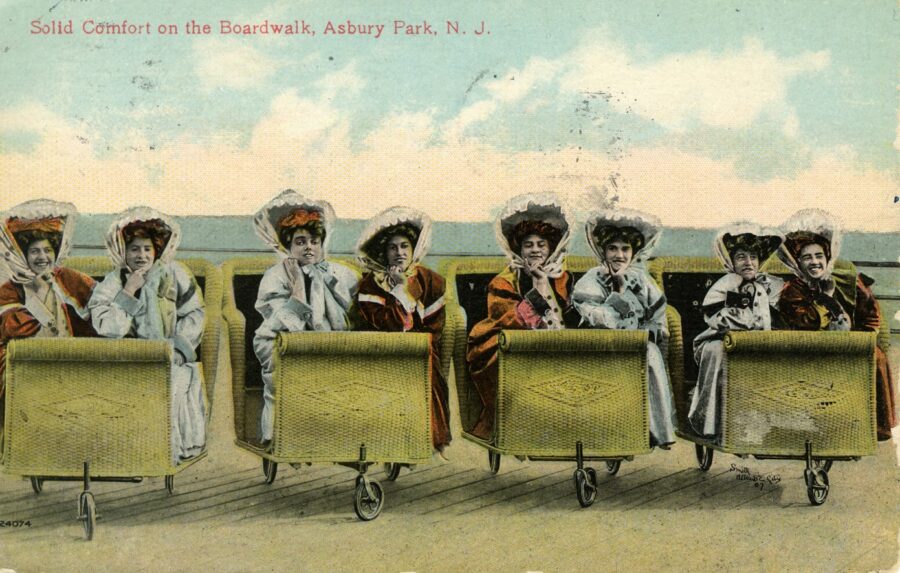
Colored Postcard showing eight women with hats on beach chairs on wheels with heading "Solid comfort on the boardwalk, Asbury Park, N.J."


To mark the opening of the Helen-Chantal Pike Collection on Asbury Park as well as to help get us out of the New Jersey winter doldrums, we share this essay on Asbury Park postcards and using postcards for research by Rachel Ferrante, Fall 2017 Public History Intern 2017 in Special Collections and University Archives.


By Rachel Ferrante


There are few things as uniquely iconic as the Asbury Park postcard. The Las Vegas neons and even the Hollywood sign may be the only two cultural images that elicit similar recognition. It seems these images embody regional leisure and tourist culture, recognizable across generations. Because these signs act as visual landmarks, the images are regurgitated in popular culture. An example is the mimicking of the Hollywood sign in the Dreamworks movie “Shrek” as the sign for the fictional city Far Far Away. Using the sign as a landmark, the rest of the scene imitates Hollywood, a defining city in West Coast culture and example of opulence.

About 2,900 miles down I-80, Asbury Park is far more humble. Since its founding in 1871, Asbury Park has repeatedly boomed and busted in its cultural significance, tapping into every aspect of leisure culture one can think of. Asbury has been a physical representation of popular culture, specifically and originally for New York elites, who seem to define high culture throughout much of U.S. history. In fact, Asbury has been a center of both high culture and subculture, making it extremely relevant to the East Coast’s, if not the nation’s, cultural memory and historical interest.
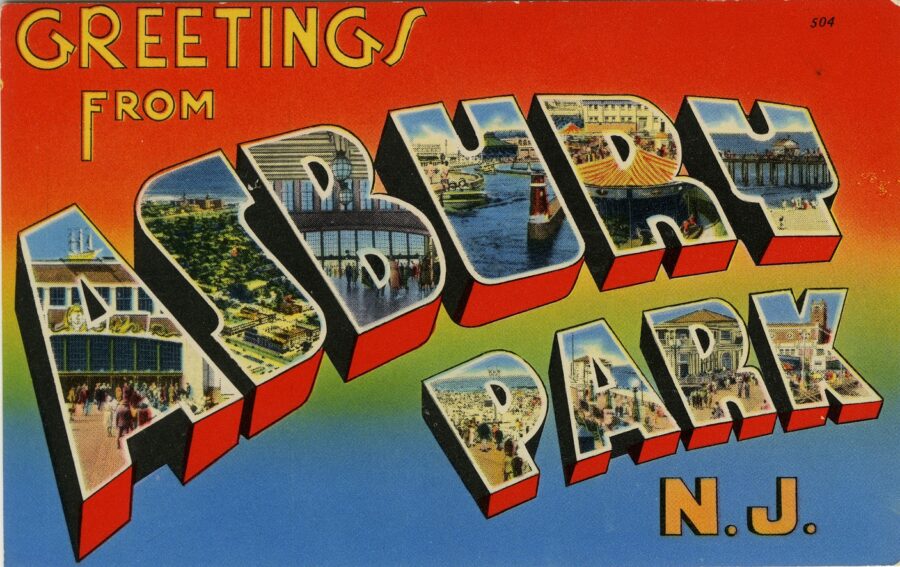
Postcard with text "Greetings from Asbury Park NJ"

The “Greetings from Asbury Park, N.J.” postcard is a specific linen Tichnor style with images geared to Asbury leisure in particular. This style was applied to many postcards centered around other places as well, the likes of which include Niagara Falls and Route 66. Famously, the Asbury postcard was used as the cover of Bruce Springsteen’s breakout album by the same name. So beyond its initial iconic stature the postcard has a history of its own. When you look at the Helen-Chantal Pike Collection on Asbury, the postcards it includes tell a story of Asbury Park’s history. Paired with the other materials in the collection, it is clear the significance certain institutions or moments in time had on the area. However, there are many more layers of significance behind the postcards. They span more than 100 years of regional history that can be contextualized in national political, social, economic, and familial histories, resulting in many potential conclusions using just postcards as primary source material. The rest of this post will address the use of postcards as research tools, using examples from the Helen-Chantal Pike Collection on Asbury Park housed at Rutgers University Special Collections and University Archives.

USING POSTCARDS FOR RESEARCH

In America, the first postcard was developed in 1873 by Massachusetts’ Morgan Envelope company. These cards depicted scenes from conventions and expositions in Chicago at the height of the Industrial Revolution. The first postcard intended for souvenir purposes was actually created in 1893 with scenes from the World’s Columbian Exposition. Postcards thus have deep roots in the northern region of the country, documenting its changing history, and capturing the excitement of progress in many eras. In 1898, Congress passed the Private Mailing Card Act, which allowed postcards to be printed by private companies rather than just the post office. At this point the popularity of “Private Mailing Cards” began to skyrocket. Finally, in 1901, private companies were allowed to call their printed cards “postcards,” and after a few more years of complicated history the picture front, divided back, postcard we all know was legal and being mailed in multiple styles across (a good amount of) the country. This Golden Age of Postcards peaked in 1910, with postcards particularly popular among rural and small town women of the northern United States.
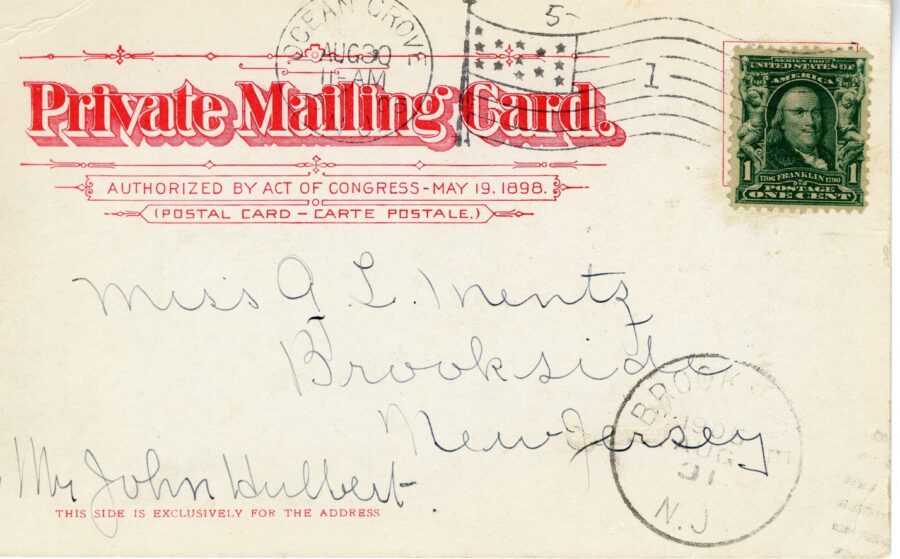
Envelope addressed to Miss G.. Mentz, Brookside, New Jersey stamped in Ocean Grove

Almost all of the eras of postcards are represented in the Helen-Chantal Pike Collection. Picking one group of postcards at random I was able to see examples of the short period of time where postcards were not divided-back and the sender had to write on the front, or image part, of the postcard. There are also many beautiful examples of the lithographic style of postcards, which were specifically popular during the Golden Age period (1907-1915). Each of these provides immense interdisciplinary relevance with each layer of ink. Some of these semantics are debated among postcard enthusiasts; however, the Golden Age of postcards, no matter what the exact date range, lines up with the foundational period of American culture. One of the major things that shaped the time leading up to the 1920s was the transformation of cinema from silent to film noir. In Asbury Park in particular, cinema was a huge part of the economy, with cinema tycoon Walter Reade even running for mayor of Asbury Park. Postcards of these theaters are great primary source examples of the importance of the erection of these edifices and the positions they held as landmarks of the region. Of the six Reade theaters in Asbury, two are featured prominently in the postcard collection: the Mayfair and the Paramount. Construction and then depiction of these places reflect civic achievement as well as provide insight into the aesthetic values of the region and the time period.

Aside from construction aesthetics many postcards provide insight into fashion. In the case of Asbury Park there are many depictions of changing beachwear trends. A 1910 lithographic postcard (seen at the start of this essay) shows a row of women in large bonnets posing coyly in carriages. The postcards in the “beach” section of the Pike Collection date from 1901 to 2001 so they document an entire century of summers, with their corresponding outfits and activities. The collection can be used to track the changing shore attractions as well. When compared to today, Asbury was previously booming with activities, ferris wheels, games, etc. There was even once a horse track where there is now a parking lot.
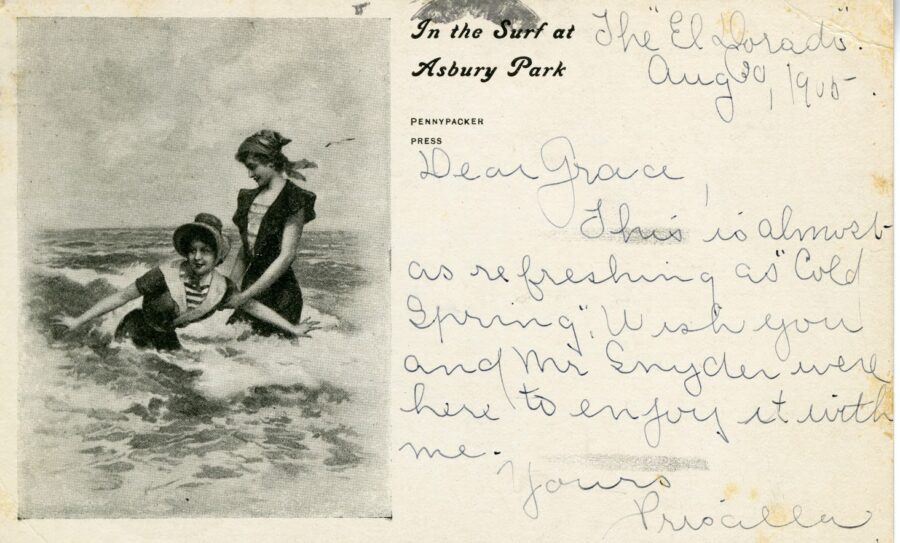
Postcard showing two women in bathrobe in the sea on the left, with note dated "The "El Dorado" August 30, 1905" with the text "Dear Grace, This is almost as refreshing as "Cold Spring." Wish you and Mr. Snyder were here to enjoy it with me. Yours, Priscilla

CONCLUSION

While the Helen-Chantal Pike Collection focuses closely on the late 19th through mid-20th centuries, it is also relevant to a variety of timely topics. Because of this, its postcard series is a great place to start research on the Asbury Park, leisure, East Coast culture and development, and visual culture. There are, at the very least, enough images to acquaint a researcher to the area and its specific civic importance. At the other end, the series can provide insight into a large amount of research projects with a fairly wide scope. An example of its relevance is the way  in which postcards pose as an interesting precursor to the visual culture we exist within today. In many ways, a postcard was the Instagram of people in the 19th century. The feelings that surround the purchase and sending of the postcard are similar to the reasons one takes photos of their vacation and travel spots today. Mailing the card has been replaced with posting on the internet and the back of the card has been replaced by the caption. In this way, postcards are also structurally similar to Instagram, balancing the impersonal nature of posting to a wide audience by allowing the image to have been captured by the individual. This, like postcards, provides a sense of community through sharing and receiving. However, it is not always to say “wish you were here,” but sometimes “look where I am.”

About

Rachel Ferrante is an undergraduate American Studies and Sociology student at Rutgers working at the Special Collections and University Archives through the Rutgers Public History Internship program. During Fall 2017, she processed the Helen-Chantal Pike Collection on Asbury Park, New Jersey. Outside of the library, she works on cultural history through research with the Aresty Program and in her papers.

To Learn More:

Works consulted:


All images displayed are postcards from the Helen Pike collection, Box 5, folder 1.


Late Fall 2016-Winter 2017 Acquisitions

Facebooktwitterredditlinkedintumblrmail


Alvarez, Ann. The Mass Grave at the First Reformed Church. New Brunswick, NJ. East Brunswick Historical Society, 2008.

American Whig Society. Catalogue of the American Whig Society. Princeton, NJ: Published by the order of the Society, Princeton University, 1865.

Bowman, Bill. Murderer of the Year: A True Story. PJB Creatives, Inc., 2009.

Boyd, William Henry. Boyd’s Newark Business Directory. Newark, NJ: A.J. Dennis & Co., 1857

Brown, Mercy. Loud is How I Love You: A Hub City Romance. New York: InterMix Books, 2016.

Clark, Rhonda L. and Miller, Nicole Wedemeyer. Fostering Family History Services: A Guide for Librarians, Archivists, and Volunteers. Santa Barbara, CA: Libraries Unlimited, 2016.

Cohen, Ronny. From Homer to Hopper: American Visions in 19th and 20th Century Art. Selections from the Permanent Collection of the Canajoharie Library and Art Gallery. Princeton, NJ: Bristol-Myers Squibb, Co., 1990 .

Degrassi, Carol. City of Somers Point: Before and After (Vol. 1).  Somers Point, NJ: Somers Point Historical Society, 2004.

Directory of the City of Trenton 1854/1855. Trenton, N.J. : J.M. Clark, R.H. Moore, J.O. Raum, 1855.

Forgosh, Linda B. Louis Bamberger: Department Store Innovator and Philanthropist. Waltham, MA: Brandeis University Press, 2016.

Friends of New Netherland and New Brunswick Theological Seminary. Reflections on the World: The Writings of Howard G. Hageman. Albany: New Netherland Publishing, 1993.

Fuentes, Marissa J. and White, Deborah Gray. Scarlet and Black Volume 1: Slavery and Dispossession in Rutgers History. New Brunswick, NJ: Rutgers University Press, 2016.

Green, Howard L. and Associates, Inc. Telephone Survey of Food Store Shopping Habits, Opinions, and Attitudes in Kings Marketing Area. Troy, MI. May 5,1989.

Green, Howard L. and Associates, Inc. In-Store Survey Results for Nine Kings Super Markets. Troy, MI. January 26, 1990.

Green Book Street Directory of Trenton and Adjacent Territory, Historic Places of Interest and General Information. Trenton, NJ: L.B. Prince, 1932.

Hajdu, David. Love for Sale: Pop Music in America. New York: Farrar, Strauss and Giroux, 2016.

Havens, Mark. Out of Season: The Vanishing Architecture of the Wildwoods. London: Booth-Clibborn Editions, 2016.

Havens, Jessie L. Cold Case: Hall-Mills Murderer Revisited. Bridgewater, NJ: Heritage Trail Association, 2016.

Jardim, Edward A. The Ironbound: An Illustrated History of Newark’s “Down Neck.” Frenchtown, NJ: Stone Creek Publications, 2016.

Karcher, Joseph T. A Municipal History of the Township of Sayreville, 1876-1920. Boston: Meader Publishing Company, 1953.

Kem-Lec-Mek: The Annual of the Students, College of Engineering. Newark, NJ: Newark Technical School, 1926.

Ketler, William H. Chronic Kicker on Politics. Camden, NJ: Outlook Company, 1900.

Listokin, David, Dorothea Berkhout and James W. Hughes. New Brunswick, New Jersey: The Decline and Revitalization of Urban America. New Brunswick, NJ: Rutgers University Press, 2016.

Lloyd, Carli and Coffey, Wayne. When Nobody was Watching My Hard-Fought Journey to the Top of the Soccer World. New York: Houghton Mifflin Harcourt, 2016.

Lurie, Maxine N. and Richard Veit. Envisioning New Jersey: An Illustrated History of the Garden State. New Brunswick, NJ: Rutgers University Press, 2016.

Masur, Louis P. Runaway Dream: Born to Run and Bruce Springsteen’s American Vision. New York: Bloomsbury Press, 2009.

McCarthy. George M. The Evolution of a Sentiment. Jersey City, NJ: G.M. McCarthy, 1905.

Monmouth County Planning Board. Study of Population: Monmouth County. Court Street and Lafayette Place, Freehold, NJ, April, 1974.

Monmouth County Planning Board. Economic Base Abstract for Monmouth County. March, 1976.

Monmouth County Planning Board. Monmouth County Planning Area 6: Land Use. Freehold, NJ. July,1976

Monmouth County Planning Board. Monmouth County Planning area 4: Land Use. Freehold, NJ. August,1977.

Monmouth University. 19th Century Maritime Art: Our History in Paintings. Pollak Gallery, October 13- 23, 2011. West Long Branch, NJ: Monmouth University, 2011.

Moss, Sandra W. Poliomyelitis: Newark 1916, “The Grip of Terror.” Xlibris, 2016.

Myers, Gordon. Yankee Doodle Fought Here: Being an Historic Musical-Narrative Featuring the Songs and Words of People who Lived in 18th Century America. Newfield, NJ: D.P.R. Publishers, 1975.

National Jewish Committee on Scouting. The Ner Tamid Guide for Boy Scouts and Explorers. New Brunswick, NJ, 1961.

Negron, Rosina. Comparison and General Analysis of Support Systems for Heritage Sites in New Jersey, California and Puerto Rico. Philadelphia: Managing Heritage for Sustainability, Graduate School of Fine Arts, University of Pennsylvania, 1999.

New Jersey National Guard, Cavalry Regiment, 102nd.  First Squadron of Cavalry NJ: Essex Troop: 100th Anniversary of the Mexican Border Campaign, 1916-1917. West Orange, NJ: 102nd Cavalry Regiment Association, 2016.

New Jersey State Highway Department, Bureau of Public Information. Development of the State Highway System: New Jersey. Trenton, NJ: 1960.

New York Shipbuilding Corporation. Safety Rules and Regulations. Camden, NJ: New York Shipbuilding Corporation, 1941.

Nutt, Charles W. Life Happens: How Catholic Baby Boomers Coped with a Changing World. Vineland, NJ: Anlo Communications, L.L.C., 2009.

Passaic County Tuberculosis and Health Association. Annual Report. Paterson, NJ: Passaic County Tuberculosis and Health Association, 1947.

Rabig, Julia. The Fixers: Devolution, Development & Civil Society in Newark, 1960-1990. Chicago: The University of Chicago Press, 2016.

Rosenfelt, David. Blackout. New York: St. Martin’s Paperbacks, 2016.

Shea, Hunter. The Jersey Devil. New York: Pinnacle Books, 2016.

Somerset County Planning Board. Draft: Somerset County Planning Board Housing Trends Assessment Report. Somerville, NJ: 2016.

Stewart, Kelly Loyd. An Illustrated History of the Society of The Cincinnati in The State of New Jersey. The Society of the Cincinnati in The State of New Jersey, 2014

Sullivan, Jaime Primak and Eve Adamson. The Southern Education of a Jersey Girl: Adventures in life and Love in the Heart of Dixie. New York: Touchstone, 2016.

Trenton, New Jersey Department of Housing and Development. Preservation Guidelines. Trenton, NJ: City of Trenton, Department of Housing and Development, 1979.

Ventresca, Yvonne. Black Flowers, White Lies. New York: Skyhorse Publishing, 2016.

Wacker, Peter O. Etching The Rural Landscape in Early New Jersey. 2000.

Webster, Noah. An American Dictionary of the English Language. New York: White and Sheffield, 1842.

Woodbury, David O. A Measure for Greatness: A Short Biography of Edward Weston. New York: McGraw-Hill, 1949.

Zampini, Daniel James. After it Rains. Haverhill, MA: Fireborn Publishing, 2016

New Brunswick Music Scene Archive Anniversary Exhibit

Facebooktwitterredditlinkedintumblrmail

An exhibit of materials commemorating the one-year anniversary of the New Brunswick Music Scene Archive is on display now in the Special Collections and University Archives Gallery at Alexander Library.

Reflecting the history of the city’s independent music since the 1980s, the display features a wide variety of objects—from records and tapes to zines, flyers, and other ephemera—that were donated from the personal collections of those involved in the scene over the years. Highlights include issues of Jersey Beat and New Brunswick Underground, flyers for shows held at the Court Tavern and the Melody Bar, and recordings from local acts such as The Blasés and The Weeping Cysts.

The gallery is open during Special Collections and University Archives’ regular operating hours.

For more information about the exhibit or the archive (including donating materials), contact New Jersey regional studies librarian Christie Lutz.

22nd Annual New Jersey Book Arts Symposium

Facebooktwitterredditlinkedintumblrmail
Slicing the Air, Carved Board Book, by Asha Ganpat

From Here to . . . There: Concept and Technique in Artists’ Books, the 22nd annual New Jersey Book Arts Symposium will be held on November 4, 2016 at the Alexander Library, Rutgers, The State University of New Jersey, 169 College Avenue, New Brunswick, NJ. The Symposium, which runs from 8:45 am until 5:00 pm will feature 7 individual book artists, and 1 collaborative pair of artists, presenting on their artists’ books, as well as 2 morning workshops, 2 readings from artists’ books during the lunchtime seminar, and an onsite work, a “registry project,” conducted by Asha Ganpat. The day will conclude in our traditional book artists jam, at which all attendees will be able to share their own work. Lunch and refreshments are included in the price of admission ($45 for general admission; $15 for Rutgers staff and faculty; students free.

For more information see


New Brunswick Music Scene Archive One-Year Anniversary Symposium

Facebooktwitterredditlinkedintumblrmail

The New Brunswick Music Scene Archive will mark its one-year anniversary with a panel discussion and exhibit from 6 to 8 p.m. on October 27, 2016 at Alexander Library.

Panelists include Brandon Stosuy, editor in chief of Kickstarter’s The Creative Independent and former editor at Pitchfork; Amy Saville, vocalist and

guitarist of New Brunswick-based Prosolar Mechanics and author of the Hub City Romance series; Kelli Kalikas, studio co-owner and show promoter at In the West recording studio in New Brunswick; and John Terry, former New Brunswick basement show promoter, record label owner, and musician. The event is free and open to the public.

Search all across the country and you are unlikely to find many research collections like the New Brunswick Music Scene Archive. In fact, only a handful of other academic institutions nationwide have begun to preserve in their archives the musical history of their local communities. But a collection such as this seems perfectly fitted to the Hub City, where acts such as Screaming Females and the Gaslight Anthem got their starts in underground venues before moving on to national and international stages.

Since its inaugural symposium last October, the archive has been enthusiastically received by those with connections to the New Brunswick music scene.

“There was a groundswell of interest,” said Christie Lutz, the archive’s co-founder and New Jersey regional studies librarian for Special Collections and University Archives. “We received many, many emails from people who wanted to donate material or share their stories from when they were involved with music in New Brunswick.”

Sometimes a flyer would arrive in the mail without warning or someone would drop by the library unannounced with a handful of records to donate. But many items—patches from the jacket of Ronen Kauffman, author of New Brunswick, New Jersey, Goodbye; or a series of elaborate zine mailers published by the Court Tavern in its heyday—came as a surprise for other reasons.

“These were unexpected because the nature of the materials makes them unlikely to be found in other archives or simply because we had no idea they even existed,” noted Frank Bridges, a doctoral student and part-time lecturer at Rutgers’ School of Communication and Information, who partnered with Lutz to establish the archive. “Ultimately, they help paint a fuller picture of a vibrant era in the city’s history.”

Lutz hopes that the anniversary symposium will build on the momentum the archive has enjoyed since its launch and deepen the conversation around both the collection and the scene.

“This year’s panelists represent very different perspectives than last year’s. Amy can speak to being a woman in a male-dominated scene in the 90s and to writing fiction about New Brunswick. Brandon has done a host of things from running a label to promoting bands, but his roots trace back to his days at Rutgers, DJing at WRSU and editing Inside Beat. And Kelli can speak about running a studio in the city—who comes in to record? How is she perceived as a woman doing this job?”

And while the process of formally accessioning, arranging, and describing the materials is a long one, Lutz already sees a number of opportunities for research and further programming.  She imagines a digital humanities project that maps points of interest across the city, examinations of women and people of color in the scene, or collaborations with other special collections in the state to tell the story of New Jersey music more broadly.

“I’m excited to see what the future has in store,” she said.


July-August 2016 New Acquisitions

Facebooktwitterredditlinkedintumblrmail

presstime_sncly2_pn4700-p74-no-4_cover001


American Whig Society. Catalogue of the American Whig Society. Princeton, NJ: Published by the order of the Society, Princeton, NJ, 1859.

ARCH2. This is the Story of Emark: A Production of Thomas A. Edison, Inc. Metuchen, NJ: ARCH2 Inc.

Berkey, Joan. Early Wood Architecture of Cumberland County. (DVD). Greenwich, NJ: Cumberland County Historical Society, 2013.

Bicentennial Farm Awards. New Jersey: 1988

Braisted, Todd W. Grand Forage 1778: The Battleground Around New York City. Yardley, PA: Westholme, 2016.

Read More

June 2016 Acquisitions

Facebooktwitterredditlinkedintumblrmail

Airships_(SNCLY3_TL650G7A371929)_Cover001

Airships: U.S. Naval Air Station, Lakehurst, New Jersey. New York: Grolier Craft Press, 1929.

Celebrating Our 125th Anniversary: Hopewell Borough, 1891-2016. Hopewell Borough, NJ: 125th Anniversary Committee, 2016.

Choroszewski, Walter. Somerset: A Celebration of Communities. North Branch, NJ: Aesthetic Press, 2007.

Church of the Guardian Angel. Commemorating Our 10th Anniversary: Church of the Guardian Angel in Allendale Souvenir Program, May 27, 1964. Allendale, NJ: Church of the Guardian Angel, 1964.

City of Cape May Historic Preservation Commission. Design Standards. Cape May, NJ: Cape May Historic Preservation Commission, 2002.

The Collage Journal: the First Decade, 2005-2015. Hunterdon, NJ: Hunterdon Art Museum, 2015. Read More

Hamilton

Facebooktwitterredditlinkedintumblrmail

By Christie Lutz

Two-hundred and twelve years ago today, Alexander Hamilton and Aaron Burr faced each other in a duel on the cliffs of Weehawken, New Jersey.

Among our Sinclair New Jersey Collection holdings, we have a handful of postcard views and other images depicting the Weehawken dueling grounds, which have seen some changes over the years. The 1810 image below depicts a bucolic scene, with boats gliding by on the Hudson River.

New Jersey Views Photograph Collection

This postcard, mailed in 1919, features the boulder on which Alexander Hamilton purportedly rested his head after being mortally wounded by Burr.  The site depicted here is not the precise site of the duel, however. The boulder was moved from its original spot to make way for train tracks. And today, the bust of Hamilton sits upon a pedestal, with the boulder sitting behind it.

Sinclair New Jersey Postcard Collection

While Alexander Hamilton himself has been the focus of recent interest, Special Collections and University Archives also holds the X-Burr Collection, a collection of books on Aaron Burr that were donated to Rutgers by the Aaron Burr Society. Below is the title page from one of the books in the collection, authored shortly after the duel by Lysander, the pseudonym of federal judge Willam P. Van Ness. Van Ness was a friend of Burr’s who served as his second in the duel.

X-Burr Collection
X-Burr Collection